
Aug 1, 2026
4 min. read
In Healthcare, Who Pays?
Healthcare has no shortage of products that work. But a surprising number never become meaningful businesses because no one has answered the “Who Pays?” question.
Discover more
→
6 min. read
The healthcare market has already reset. But the reset isn’t over. Market prices can adjust quickly. Capital structures can’t.

Written by
Dan Neuwirth
Managing Partner
·
Realize Health Ventures
Back to all Insights
←
The healthcare market has already reset.
Valuations are lower. Capital is more expensive. Buyers are more selective. Growth without profitability carries less weight. The assumptions that supported much of the 2020 and 2021 investment cycle no longer hold.
That is because market prices can adjust quickly. Capital structures can’t.
Healthcare entered the pandemic investment boom with several powerful tailwinds at once. Interest rates were low. Debt was abundant. Venture capital was plentiful. Public-market valuations climbed. Private equity competed aggressively for assets across healthcare services, technology and life sciences.
In digital health alone, U.S. companies raised nearly $30 billion in 2021, almost twice the record set only a year earlier. Large financing rounds became common. Revenue multiples expanded. Growth was frequently valued well ahead of profitability.
Private equity was operating under many of the same conditions. Fragmented healthcare markets offered seemingly endless opportunities for consolidation. A familiar strategy emerged: acquire a platform, add smaller businesses, use leverage and eventually sell the larger enterprise at a higher multiple.
For a while, the environment helped make the math work.
Then the cost of capital changed.
KKR, one of the world’s largest alternative investment firms, argues in its latest capital-market assumptions that falling interest rates, multiple expansion and broad asset appreciation are likely to be less dependable sources of return than they were during the previous cycle. The conclusion is not that attractive returns disappear.
That distinction matters for healthcare. The decline in transaction multiples tells one part of the story.
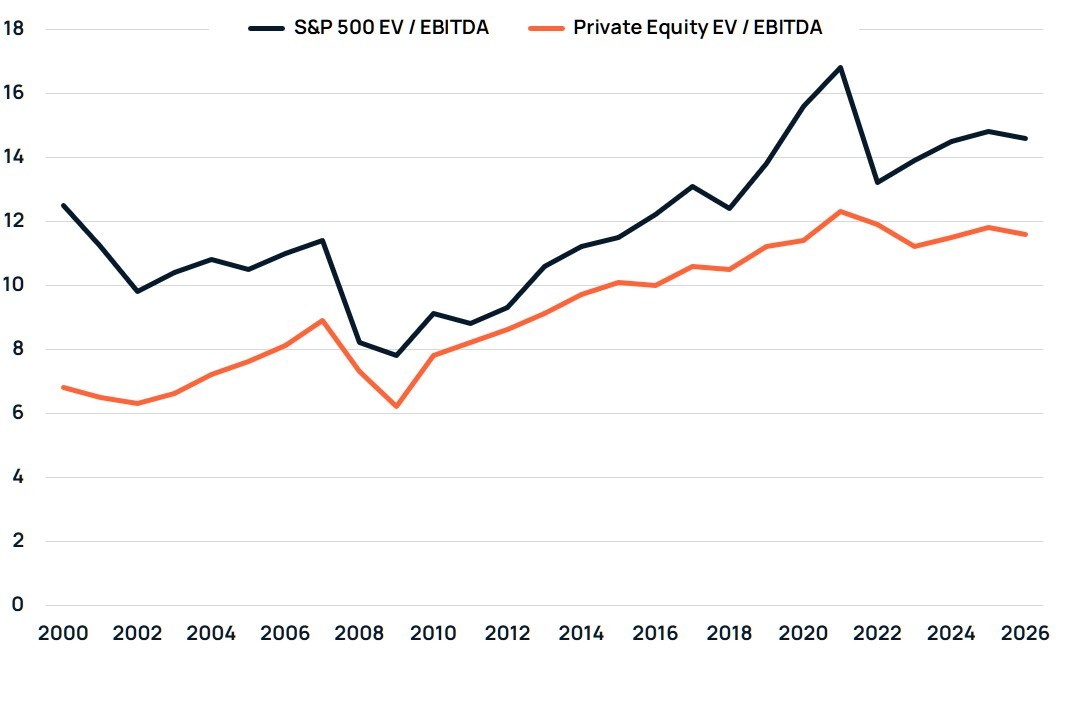
The harder part is what happens to companies acquired or financed before the decline.
A healthcare company may have raised capital at a $300 million valuation in 2021 and be worth substantially less today even if the business has grown. A private-equity sponsor may own a good company purchased at a multiple that the current market will not reproduce. Preferred investors may sit ahead of founders and employees in a capital structure built around an exit value that no longer looks realistic.
Those valuations did not disappear when the market corrected. They stayed on the cap table.
Markets can change their minds remarkably fast. Cap tables are more sentimental.
That has created a meaningful group of healthcare companies in an uncomfortable position.
The natural response has been to wait.
Extend the holding period. Cut expenses. Raise an inside round. Amend debt. Push the exit date out another year. Hope earnings grow into the old valuation or that the market eventually comes back.
For some companies, that will work.
For others, waiting has slowly become a strategy mostly because nobody has chosen a different one. Nobody wants to be the one who recognizes the loss.
For a growing number of healthcare companies, 2027 may be the year that decision can no longer be deferred.
That is one reason the next phase of healthcare M&A could look different from the last one.
A founder-backed company sitting below its last private valuation may need a recapitalization rather than another traditional financing round. A PE-owned asset purchased near the top of the market may make more sense as part of a strategic combination. A healthcare technology company with valuable intellectual property but insufficient distribution may be worth more inside a larger organization than it is as an independent business.
In other cases, the answer may be a minority investment, carve-out, structured transaction or sale to a buyer that can create value unavailable to the current owners.
The objective is no longer necessarily to recover yesterday’s valuation.
Yesterday’s valuation has already had its turn.
That principle extends beyond companies carrying legacy valuations.
The investment environment itself is becoming less forgiving.
KKR expects interest rates to remain materially above the levels that defined much of the previous cycle and argues that investors should rely less on valuation expansion and more on earnings durability, productivity, free cash flow and operational improvement.
That puts greater weight on attributes that could be overlooked when capital was cheap.
Recurring revenue matters. Reimbursement visibility matters. Customer retention matters. Cash conversion matters. So does the ability to grow without adding people and expense at the same rate as revenue.
The difference between a good healthcare market and a good healthcare company is becoming harder to ignore.
Healthcare investing has periodically become overly thematic. Behavioral health is attractive. Home-based care is attractive. Healthcare IT is attractive. Physician practice management is attractive. Whatever category is in favor begins to carry some of the investment thesis by itself.
At some point, the sector starts doing a little too much of the work.
But two companies in the same sector can have radically different economics.
One may have diversified customers, stable reimbursement and a scalable operating model. Another may rely on a few customers, continuous hiring and reimbursement assumptions that have never been tested through a difficult market.
The category is the same. The investment is not.
That dispersion creates opportunity, particularly in the lower middle market.
Many smaller healthcare companies have built something genuinely valuable without becoming particularly sophisticated organizations. Founder-led sales still drive growth. Pricing evolved by instinct. Technology systems do not communicate. Administrative processes remain heavily manual.
For years, private equity’s most visible contribution to these businesses was often capital and acquisitions.
Technology adoption, better pricing, workflow redesign, procurement, revenue-cycle improvement and professionalized sales can materially change the economics of a healthcare business without requiring the market to assign it a higher multiple.
Artificial intelligence will increasingly be evaluated the same way.
By 2027, describing a company as “AI-driven” will have little value on its own. Most companies will claim to be AI-driven or something like it.
No company will be willing to describe themselves as “AI-reluctant”.
The more relevant questions will be economic.
Does AI allow the same workforce to support more patients? Does it reduce documentation or administrative labor? Does it accelerate collections? Does it improve diagnostic accuracy enough to reduce downstream cost? Does it make a labor-intensive service scalable?
If it does, AI may change the investment case.
If it does not, it is mostly a feature.
The same standard should apply to consolidation.
Healthcare will continue to consolidate. Many markets remain fragmented, and scale can create legitimate advantages in purchasing, payer contracting, technology and overhead.
A five-company platform that still operates like five separate companies is not necessarily a better company.
It is simply a larger one.
Sometimes with a nicer PowerPoint.
Scale matters when it changes the economics.
That can mean stronger contracts, more efficient staffing, centralized technology, broader distribution or the ability to support capabilities that smaller organizations can’t afford on their own.
Without those benefits, bigger is mostly bigger.
None of this suggests that healthcare will become less attractive to investors in 2027.
The long-term fundamentals remain powerful. Demand continues to grow. Medical innovation continues. Aging demographics remain favorable. The system still contains enormous inefficiencies.
What has changed is the margin for error.
The next cycle will reward investors and companies that can create value through execution, productivity and strategic fit rather than assuming capital markets will do it for them.
And it will force another group of companies to confront a different reality:
The business may be viable even when the old valuation is not.
That is why the valuation reset is not over.